Work project
Collection Campaign Automation
Campaign tracking and database cleanup during the data internship
The scripts and notebooks I wrote during the internship to track the campaigns of the revenue-collection area and clean up its databases.
What it is about
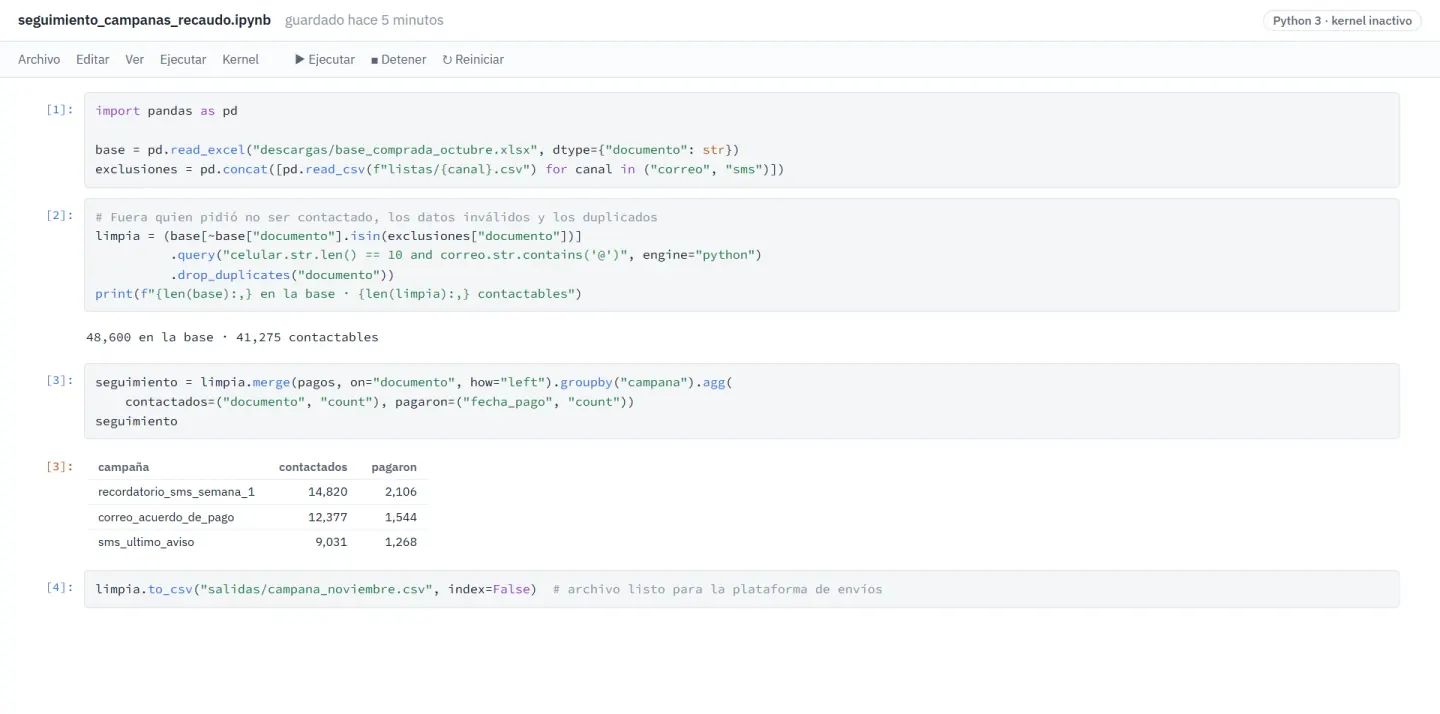
During the Quipux internship I worked in the revenue-collection automation team. These 18 repositories hold what I wrote for that daily work, across campaign tracking, database cleanup and exclusion lists.
They are private and have been archived since 2023.
What it does
- Pandas notebooks for the daily tracking of the campaigns in several cities.
- Cleaning and joining purchased databases before using them in a campaign.
- Email and SMS exclusion lists updated with every send.
- Automatic downloads, filters and file splitters with Python and batch scripts, and generating and fixing the files of each campaign.
- The analysis of the 2023 collection payments.
How it works
From files to campaign
Input files go through notebooks and scripts that produce the tracking, the exclusions and each campaign's files.
Inputs
- Automatic downloads
- Purchased databases
- Send statuses
Processing
- Pandas notebooks
- Filters and splitters
- Joins and concatenations
Outputs
- Daily tracking per city
- Email and SMS exclusion lists
- Each campaign's files
Decisions and their costs
One repository per task
The daily work left many different scripts for campaign tracking, database cleanup and exclusion lists.
Stack
Pick a technology to see the projects that use it.